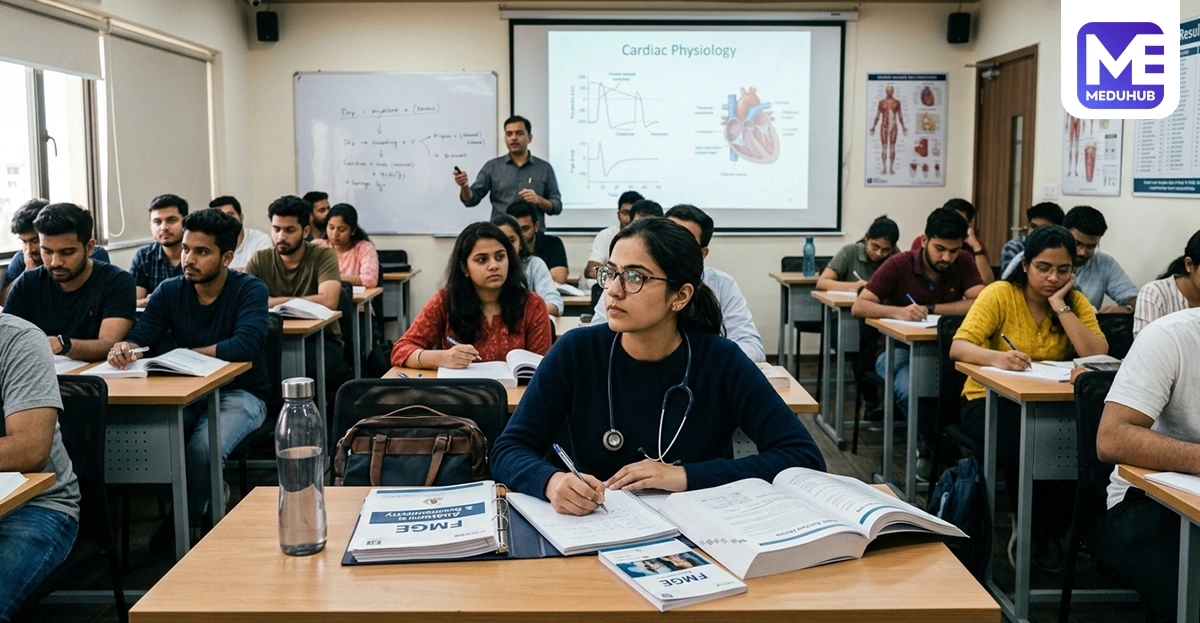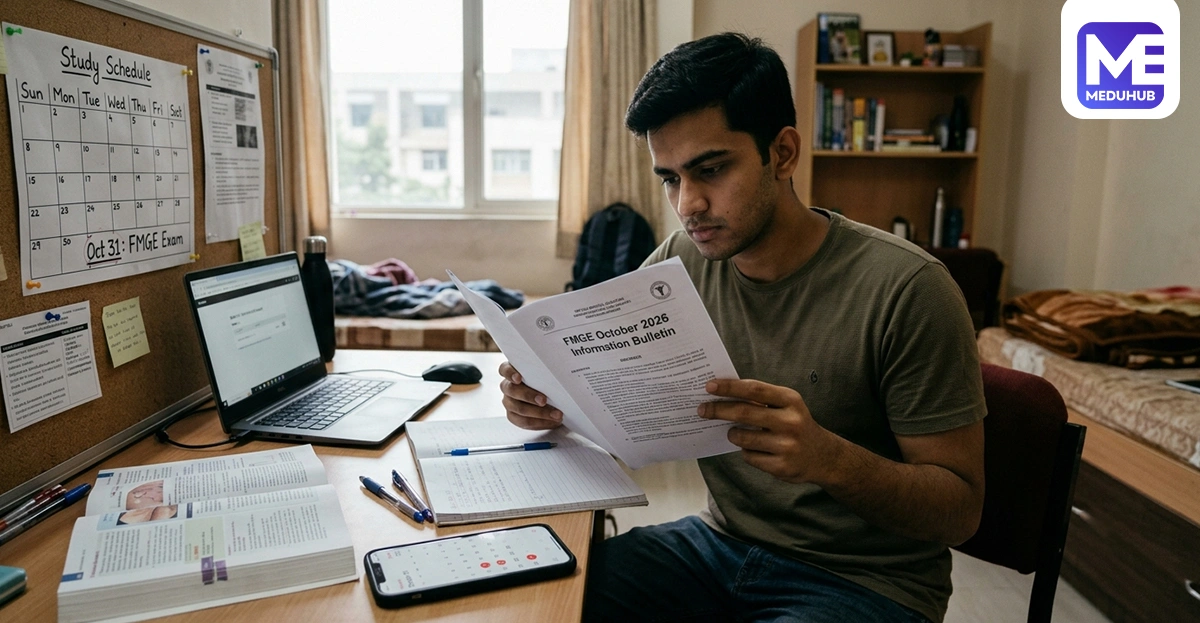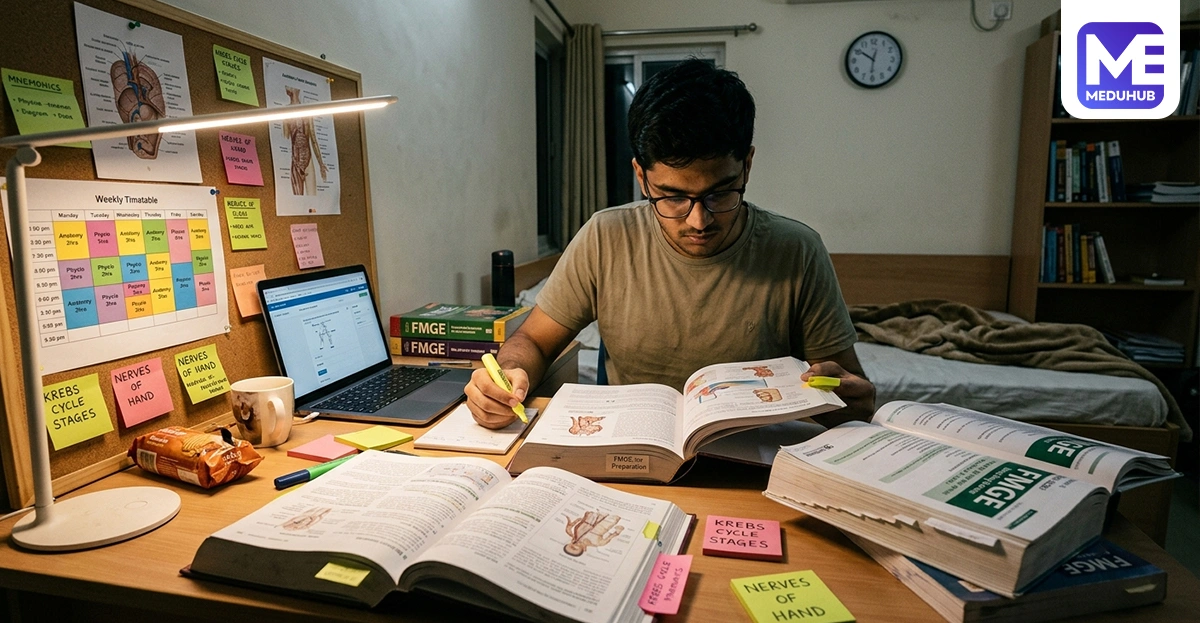
While preparing for the Foreign Medical Graduate Examination (FMGE), one cannot just depend on spending long hours on their study. The idea is that most students think that spending 12-14 hours reading will assure them success. However, having a structured plan, consistency, and proper revision have much more significance than the number of hours spent at the desk.
If you are going to prepare for the exam, then knowing about FMGE study hours can help you be productive and not exhausted. While following the right strategy, regular practice, and effective revision, a realistic schedule can help you do wonders.
Before drawing your timetable, it is necessary that you get well-acquainted with the pattern and syllabus of the FMGE Exam schedule since these define how you can utilize your time while preparing. As per the NBEMS guidelines, FMGE is a computer-based screening examination consisting of 300 multiple-choice questions in two parts. You need to score a minimum of 150 marks.
Most of those FMGE daily routine aspirants who end up being successful are not necessarily the ones who study the most. Two individuals may end up spending 8 hours in their studying routine each day, but the one who sticks to an organized method will do better. The following should be your priority, not the number of hours spent studying:
It enables you to keep information in your mind for a long time without suffering from burnout as the exam period approaches.
There isn't a single study-hour formula that works for every student. Your preparation time depends on your current knowledge, internship status, and how many months remain before the exam. Here's a practical recommendation:
Rather than suddenly increasing your workload, gradually build your study hours over several weeks. This improves concentration and makes your routine sustainable.
Copying some other person's schedule is one of the major mistakes made by aspirants. The routine for your FMGE daily routine should suit your energy levels and learning style, etc. Some essential aspects of an effective routine can be:
Consistent adherence to a realistic routine is better than studying hard for a few days only.
A well-planned FMGE study schedule should balance learning, revision, MCQ practice, and self-assessment. Instead of studying one subject for an entire day, divide your schedule into focused sessions to improve concentration and memory retention. Here's an example of a productive daily timetable:
This routine ensures every day includes concept-building, application through MCQs, and revision the three pillars of FMGE strategy.
Not every subject requires equal study time. High-weightage clinical subjects generally demand more attention, while smaller subjects should be revised frequently using concise notes. A practical weekly distribution could be:
Adjust these hours according to your strengths and weaknesses rather than following a rigid timetable.
Increasing your FMGE preparation tips will not lead you towards good results if these hours do not bring productivity to you. You should learn actively instead of passively going through books. Here are some FMGE exam preparation tips for you:
According to the official NBEMS source, the FMGE tests your knowledge on the entire MBBS syllabus using a computer-based test.
Instead of preparing randomly, divide your preparation into three clear phases.
This phased approach helps maintain consistency while reducing last-minute stress.
It may be seen that there are some students who are hardworking yet face difficulties due to a lack of direction in their preparations. The following points should be avoided while preparing for the FMGE exam:
An organized and practical approach toward the FMGE exam is much better than doing unnecessary hard work without proper planning. Recent discussions with successful candidates also indicate that revision and mock test analysis are more important than mere hard work.
Solving FMGE does not involve spending the maximum number of hours preparing. A systematic approach to learning, regular revisions, practice tests of multiple-choice questions, and timely mock exams shall consistently outperform a haphazard approach to studies involving long, fruitless hours spent on preparing.
The recommended hours of preparation for FMGE depend on the period left before the exam, but it is imperative to emphasize consistency. Regardless of whether one prepares for 5 or 10 hours each day, the focus shall be on concept understanding, mistake analysis, and repeated revisions. Adhering to a proper FMGE study schedule and adjusting the FMGE preparation strategy will increase confidence and improve the chances of passing the exam.
It is vital to understand that the FMGE is a screening test and the key to success involves the ability to apply concepts to practical situations rather than memorization. Be patient, believe in yourself, and monitor your progress through mock tests rather than by the amount of time you spend studying. NBEMS issues official bulletins, notices, and updates related to FMGE regularly.
Most aspirants benefit from studying 6–8 hours daily during the initial preparation phase. As the exam gets closer, increasing your FMGE study hours to 8–10 hours, along with regular revision and mock tests, can be more effective.
No. Studying for 12 hours is not mandatory. Consistent, focused learning with proper revision and MCQ practice is more productive than spending long hours without concentration.
An ideal FMGE daily routine should include:
This balanced approach helps improve retention and reduces exam stress.
The preparation period depends on your academic background. Most candidates prepare effectively within 6–12 months, while those with a strong MBBS foundation may require less time with a focused revision strategy.
Yes. Mock tests help improve time management, identify weak subjects, and familiarise you with the computer-based exam format. Reviewing your mistakes after every mock test is equally important.